
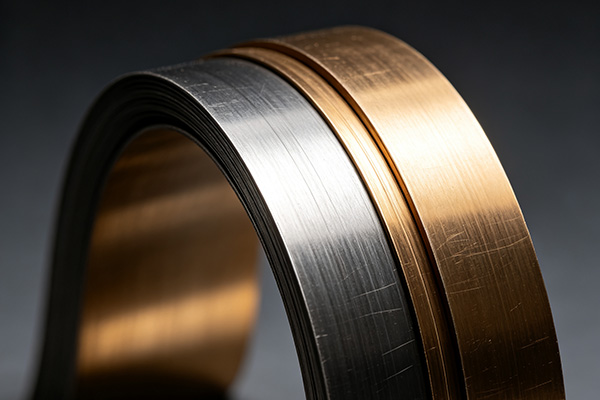
In fields such as industrial automatic control, electrical protection, home-appliance temperature control and instrumentation, thermal bimetal strip is an indispensable core heat-sensitive composite material. Leveraging the physical property of differing thermal expansion coefficients, the material autonomously converts temperature changes into mechanical deformation without external control structures such as power or chips. With stable performance, long service life, broad adaptability and controllable cost, it has become a basic core element of various temperature-control, overload-protection and automatic-switching devices. As home appliances become intelligent and industrial equipment safer, bimetal strip manufacturing processes keep improving, product accuracy and stability rise, and applications continue to broaden across civilian appliances, industrial electronic control, precision instruments and security equipment.
I. Basic Structure and Working Principle of Bimetal Strip
Thermal bimetal strip is a layered composite made of two or more alloy layers with markedly different linear expansion coefficients firmly bonded by a precision cladding process; it is the most widely used functional heat-sensitive material on the market. Its layers are clearly defined and functionally divided into two main structures, the active layer and the passive layer; some high-end precision types add a functional intermediate layer for special operating conditions.
The alloy layer with the larger thermal expansion coefficient is the active layer; it is more sensitive to temperature changes and deforms more when temperature rises or falls. The alloy layer with the smaller thermal expansion coefficient and weaker deformation is the passive layer, providing shape-setting and position-limiting stability. For applications with special requirements for temperature-control precision or resistance, a dedicated intermediate layer can be added between the active and passive layers during production, mainly to precisely adjust the overall resistance and optimize temperature-control response speed and operating stability.
Its core working principle relies on the materials' differing thermal expansion: when the ambient or equipment operating temperature changes, the active and passive layers expand and contract to different degrees; because the two layers are tightly bonded and mutually constrained and cannot expand or shrink freely, they ultimately drive the whole strip into regular bending or rotational deformation. When temperature returns to normal, the strip automatically resets; the deformation is reversible and repeatable, enabling temperature sensing, mechanical triggering and circuit on/off and other automatic control functions.
II. Core Bimetal Strip Manufacturing Processes and Their Comparison
The inter-layer cladding process is the core key process in thermal bimetal strip manufacturing, directly determining inter-layer bond strength, deformation accuracy, stability and service life. Depending on production conditions and product precision requirements, the industry has developed fusion cladding, double-pouring, hot rolling, cold rolling and explosive cladding methods, with significantly different principles, product quality and applications; currently hot rolling and cold rolling dominate mass production.
1. Mainstream Mass-Production Process: Hot-Rolling Cladding
Hot rolling is currently the most widely used and most cost-effective cladding process, suited to high-volume, standard-precision bimetal strip and sheet production. Its core flow: the prepared active-layer and passive-layer alloy slabs are accurately aligned and assembled, then under high-temperature heating a large rolling mill applies a very large reduction for high-temperature hot-roll cladding, so the multi-layer slabs are tightly fused under high temperature and pressure into an integrated structure, achieving a firm inter-layer bond. The hot-roll-clad blank then goes through several conventional cold-rolling, leveling and finishing passes to become standard-specification strip and sheet. The process is efficient and suited to large-scale mass production, and is widely used for general-purpose bimetal strip in ordinary home appliances and conventional electronic control equipment.
2. High-Precision Benchmark Process: Cold-Rolling Cladding
The cold-rolling method is the industry's highest-quality, highest-precision high-end manufacturing process, focused on precision bimetal strip and suited to precision instruments, high-end industrial control and high-precision temperature-control equipment. Unlike hot rolling's high-temperature processing, it completes cladding entirely at room temperature: after aligning and fixing the alloy slabs of different components, a high-precision cold-rolling mill applies a very large reduction, relying on strong mechanical compression to tightly bond the multiple alloy layers and avoiding the material performance degradation, inter-layer deviation and surface oxidation caused by high-temperature processing. After cladding, the strip is finished through conventional cold rolling, precision polishing and dimensional calibration. Cold-rolled bimetal strip has more uniform inter-layer bonding, more precise deformation response, stronger performance stability and longer service life, with no high-temperature defects, making it the preferred base material for high-end precision heat-sensitive elements.
3. Other Auxiliary Cladding Processes
Fusion cladding, double-pouring and explosive cladding are mostly niche auxiliary processes, suited only to special specifications and materials. Fusion and double-pouring methods are mainly used for custom thick bimetal sheet, with lower process precision and larger finished-product errors. Explosive cladding uses explosion impact to bond sheets, mostly for special heavy-thick plate; it has high cost and poor consistency and cannot scale to thin strip, so it is rarely used for conventional bimetal strip. Overall, the thermal bimetal products on the market are mainly in strip and sheet forms, with standardized specifications and strong adaptability.
III. Detailed Application Scenarios of Bimetal Strip Across All Fields
With stable temperature-induced deformation, no power supply needed, interference resistance, high/low temperature tolerance and long service life, bimetal strip as a core heat-sensitive element is widely used in automatic control devices and instruments for temperature control, temperature compensation, current limitation, temperature indication and safety protection, covering civilian home appliances, industrial electrical equipment, precision equipment, security equipment and fluid control.
1. Home Appliance Temperature Control and Safety Protection
In home appliances, bimetal strip is most widely used as the core element of appliance temperature control and overload protection. Common applications include temperature-control appliances such as electric irons, rice cookers, refrigerators, ovens and constant-temperature boxes, which use the thermal deformation of bimetal strip for precise temperature regulation and to prevent over-temperature operation. Various appliance protectors, electronic protectors and overload protectors are also built around bimetal strip, which automatically deforms and cuts power when the equipment overheats from overload, avoiding appliance burnout and short-circuit fires. In addition, small devices such as fluorescent lamp starters and civilian lighters also use the physical properties of bimetal strip for triggering and operation.
2. Industrial Electrical and Automatic Control Equipment
In industrial low- and medium-voltage electrical applications, bimetal strip is a key material for automatic control and safety protection, widely used in circuit breakers, smart switches, thermal relays, current-type automatic control switches and automatic safety protection switches. It precisely senses circuit overload and equipment overheating and quickly triggers power-off protection, safeguarding industrial circuits and equipment. It also provides temperature sensing and mechanical regulation in industrial automatic control equipment such as steam traps and temperature regulators, suiting complex industrial conditions.
3. Precision Instruments and Detection Equipment
In precision detection and meteorological monitoring, bimetal strip's stable deformation accuracy is used to make bimetal thermometers, meteorological instruments and other precision equipment that accurately sense ambient temperature changes for temperature detection and data feedback. With vibration resistance, strong stability and high/low temperature tolerance, it outperforms traditional temperature-sensing elements and is widely used in laboratory testing, meteorological observation and industrial equipment temperature measurement.
4. Fluid Control Valve Equipment
In fluid control, bimetal strip can serve as a heat-sensitive driving element in medium- and low-pressure gas and liquid valve switching equipment. It deforms with changes in ambient or medium temperature to automatically drive valves open and closed, achieving temperature-linked automatic control of fluid lines without manual operation or power. It is widely suited to fluid pipeline systems in HVAC, chemicals and water supply/drainage.
IV. Industry Development Advantages and Prospects
Compared with electronic thermal sensors, bimetal strip works on a purely physical deformation principle and offers the unique advantages of simple structure, low failure rate, electromagnetic interference resistance, high/low temperature tolerance, no power supply and suitability for harsh conditions, while being low-cost and mass-producible, making it an irreplaceable basic material in electrical temperature control and safety protection. With continuing upgrades in cold-rolling cladding precision, the accuracy, stability and durability of bimetal strip keep rising, gradually extending from conventional civilian use into high-end fields such as new energy equipment, precision industrial control, intelligent security and high-end equipment manufacturing, with a continuously expanding market space.