
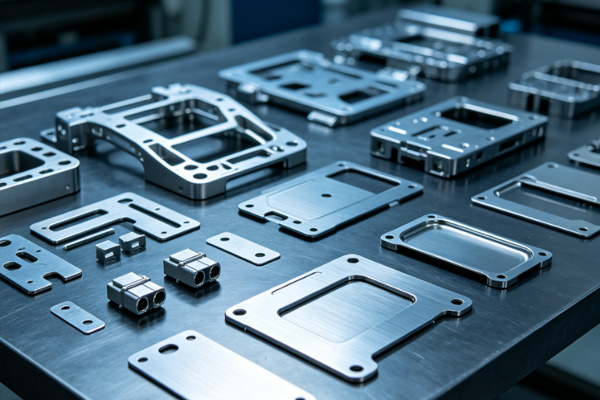
Precision stamping parts are thin-sheet metal hardware, i.e. parts that can be processed by stamping, bending, drawing and other means; a rough definition is parts whose thickness does not change during processing. They are contrasted with castings, forgings and machined parts. For example, the outer metal shell of a car is a sheet metal part, and some stainless steel kitchenware is also sheet metal.
There is as yet no fully complete definition of stamping parts. According to a definition in a foreign professional journal, sheet metal work is a comprehensive cold-working process for thin metal sheets (usually below 6 mm), including shearing, punching/cutting, combining, folding, welding, riveting, splicing and forming (e.g. car bodies). Its notable feature is that the thickness of a given part is uniform.
Stamping/sheet metal work is also an automotive repair technique: deformed parts of a car's metal shell are repaired, for example a dent in the body shell can be restored to its original shape by sheet metal work.
The basic equipment of a typical stamping plant includes shearing machines, CNC punch presses/laser, plasma and water-jet cutting machines/combination machines, press brakes, and various auxiliary equipment such as decoilers, levelers, deburring machines and spot welders.
Usually, the three most important steps in a stamping plant are shearing, punching/cutting and folding.
Stamping parts are also called sheet metal work; generally, metal sheets are made to undergo plastic deformation by hand or die stamping to form the desired shapes and dimensions, and may further be made into more complex parts through welding or a small amount of machining. For example, common household chimneys, sheet-metal stoves and car bodies are all sheet metal parts.
Stamping part processing is called sheet metal fabrication. Specific examples include making chimneys, iron buckets, oil tanks and oil cans, ventilation ducts, elbows and reducers, round-to-square transitions and funnels from sheet; the main processes are shearing, bending and edge folding, curve forming, welding and riveting, requiring some knowledge of geometry.