
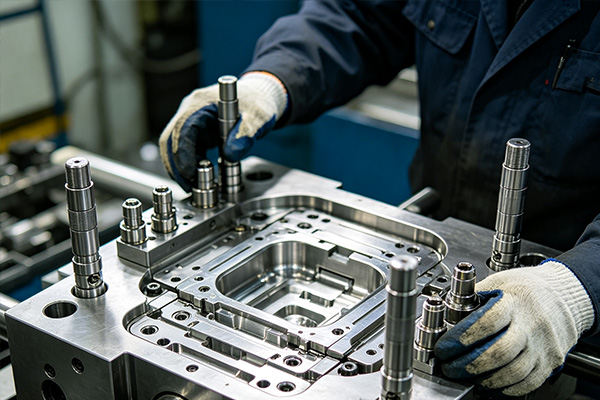
As economic globalization deepens, competition in the mold industry has long broken through geographic limits and fully entered a global contest. As a core supporting industry of manufacturing, the mold industry is highly open and fully competitive; whether large-scale mold enterprises or small and medium precision mold makers, all face global peers' competition in technology, quality and cost-performance, and the industry has entered a new survival-of-the-fittest cycle.
At present, the domestic mold industry is dominated by small and medium private enterprises, most of limited scale, like “small sailboats” in the industry, small in size and weak in overall risk resistance. In fierce global competition, small and medium mold enterprises that rely solely on traditional mass production, low-price competition and generic mold orders can hardly break through bottlenecks and achieve long-term development. Benchmarking the logic of industry leaders, the core of long-term development is not short-term order expansion but precise strategic positioning. As Jack Welch, the former GE executive, said: “I don't do many things all day, but there is one endless job—planning the future.” For mold enterprises, a clear development strategy suited to their own positioning is the most core and efficient measure for improving quality and efficiency and overtaking on the curve.
I. Focus on Niche Segments and Deepen Technology to Achieve Differentiated Breakthroughs
In a mold market with severe homogeneous competition, a large-and-complete business model easily falls into price involution, while a small-but-refined, focused-and-excellent niche deep-cultivation model is the core path for small and medium mold enterprises to break through competitive barriers. Enterprises should abandon blind expansion, precisely lock onto a single niche mold category, and concentrate resources to deepen technology and refine processes, building a unique core competitiveness.
Take the automotive lamp mold segment: an enterprise can focus on this vertical niche and concentrate all R&D, production and process optimization resources there. By continuously deepening its understanding of the segment's technical characteristics, product process standards and market iteration needs, it builds up over time a dedicated technical system, design specifications and precision machining standards. Through day-by-day process accumulation, technology iteration and experience buildup, it gradually forms differentiated technical advantages and a mature production system, precisely solving core pain points in lamp mold forming accuracy, light transmittance, adaptability and service life. With long-term deep cultivation, the enterprise can build a reputation and a firm foothold in the vertical niche, forming a core competitiveness hard for peers to copy and escaping low-end homogeneous competition.
II. Stabilize the Technical Talent Pipeline to Build the Core Foundation of Development
The mold industry is technology-intensive; process R&D, precision design and high-end production rely heavily on professional technical talent, and a stable technical team is the core backing for an enterprise to deepen niche markets and keep iterating. After defining the niche segment and upgrading process specialization, the top priority is stabilizing core technical human resources, especially senior technical backbones, senior design engineers and precision process technicians.
Looking at the development models of quality overseas high-end mold enterprises, most high-end mold makers are not very large, but with refined, high-end product positioning they maintain high-margin, high-value-added operations, with very stable internal teams and very low talent turnover. Their core logic is to focus on talent retention and technical accumulation, using sound incentive mechanisms, growth systems and working atmosphere to unite the team and deepen core technology. For small and medium mold enterprises, stabilizing core technical talent, continuously accumulating process experience and iterating the technical system are far more important than short-term order profits, and are the core confidence for steady long-term development.
III. Optimize Mold Structure Design and Use Digitalization to Improve Product Accuracy and Life
Mold structure design is the core source of mold production; design accuracy and structural rationality directly determine forged-part quality, production efficiency, mold life and cost, and it is the first key process in mold quality control. As the mold industry upgrades toward precision, intelligence and efficiency, the traditional human-experience design model can no longer meet high-end production needs, and digital, simulation-based optimization design has become the mainstream trend.
At this stage, quality mold manufacturing generally uses computer numerical simulation combined with physical simulation for verification to comprehensively optimize mold structure design. Digital simulation can precisely calculate metal flow paths, filling rates, die-cavity filling and the overall stress distribution of the mold, ensuring smooth metal flow and full cavity filling, avoiding stress concentration, forming defects, deformation and cracking, and improving mold forming stability from the source.
At the same time, enterprises can use mature CAD systems for integrated 2D and 3D precision design, ensuring the unity and accuracy of original product data and design parameters, minimizing human design errors and parameter deviations and greatly raising overall mold design quality. 3D solid modeling fully restores the product's appearance and internal structure, checking structural flaws, dimensional deviations and process defects in the original design before forging production and optimizing them in advance, effectively reducing later mold modification and repair costs and improving production efficiency.
In addition, the rationality of forging die structure profoundly affects overall production efficiency and is directly linked to forged-part quality, production line efficiency, manual labor intensity and mold life. In mold design, the preforming (blank preparation) process must be precisely planned based on the forging's cross-sectional area and volume, optimizing preform shape and dimensions to match pre-forging and final-forging die standards. Unreasonable preform structure, large dimensional deviation, or severe wear of the preform cavity not corrected in time will directly increase the load on subsequent forging dies, accelerate die wear, greatly shorten the life of pre-forging and final-forging dies, and raise production costs and equipment maintenance pressure. Therefore, refined, digital optimization of mold structure is the core key for mold enterprises to improve quality, reduce cost and increase efficiency.
IV. Industry Summary: Precise Layout Is the Core of Long-Term Development for Mold Enterprises
In an increasingly competitive global environment, the core of development for small and medium mold enterprises is no longer scale expansion but precise, specialized and refined upgrading. Clear strategic planning, deep cultivation of vertical niches, a stable talent pipeline and digital structural design—these four dimensions complement each other and form the core system for mold enterprises to break out of industry involution and participate in global competition. In the future, as demand for refined manufacturing keeps rising, quality mold enterprises that focus on niches, deepen technology and strictly control quality will continue to capture high-end market share and achieve steady, high-quality development.